
Newsletter Subscribe
Enter your email address below and subscribe to our newsletter
Enter your email address below and subscribe to our newsletter


Daily Vector
Daily Vector

 I often get asked if I have a favorite price action chart pattern to trade, and the answer is yes, yes, I do. Today’s lesson is about that chart pattern, it’s what I call my ‘deserted island strategy’ because if I were stranded on a deserted island and could only pick one trading strategy or signal, it would be the one I am going to share with you today…
Pin bars, in general, are my favorite overall price patterns to trade, mainly because they are simple, powerful and consistent. The pin bar has stood the test of time; go back and look at charts from 50 years ago, you will see pin bars worked then and they work now.
However, not all pin bars are created equal, perhaps you may think this is unfortunate, but if you learn to identify and trade them properly you will quickly change your mind. One type of pin bar in particular, the ‘long-tailed pin bar’, is probably the most important signal I have witnessed in my 15 + years of trading. Long-tailed pin bars are like the so called ‘black swan’; rare and beautiful and when you see one you stop and stare in awe, primarily because you know how important they are and how much money you can make from them, and if you don’t know, you will know after reading the rest of this lesson…
Pin bars come in all different sizes, but they can basically be categorized into two camps: ‘Normal’ pin bars and ‘Long-Tailed’ pin bars. However, if you do not know anything about pin bars, I suggest you stop for a minute and go over my pin bar trading tutorial to get familiar with them before continuing.
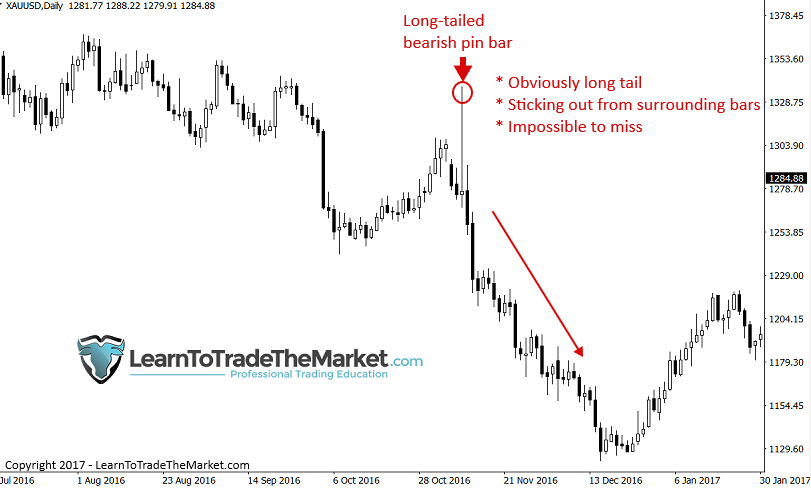
So, what does a long-tailed pin bar look like?
Here is an example:
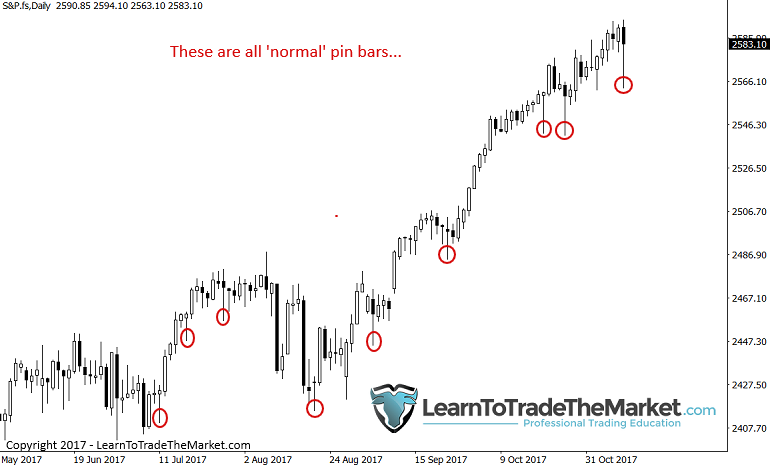
In contrast, here is a chart showing what I would consider ‘normal’ sized pin bars…
Here are the most important characteristics and things to know about long-tailed pin bars:
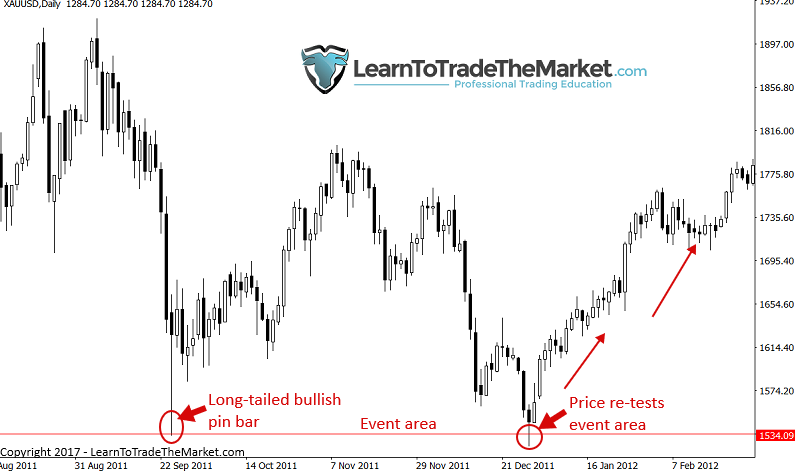
One of the most important things to understand about long-tailed pin bars, is they are not JUST a signal you trade one time. Often, they are so powerful that they can re-shape the market’s ‘landscape’ for months or even years to come. After a long-tailed pin has formed and the market reacts in-line with the pin bar, we can then begin to ‘map the market’ based off that pin. I teach traders to read the market like a book, from left to right, to understand the ‘story’ the market is trying to tell you. When a long-tailed pin bar forms, it’s a very important part of the ‘story’ that will have implications for ‘chapters’ to come. For example, the market may come back and re-test the area where the pin bar formed, in which case, we would trade according to my event area theory.
You see, long-tailed pin bars are not just trade signals, they are that and a lot more. They help us understand the dynamics of a market and the psychology of the people trading it. A long-tailed pin bar typically shows a final exhaustion point in a market, or in the case of a trend continuation move, it’s a strong confirmation signal that a trend will continue. The long-tail on the pin bar shows that market participants became overwhelmingly bearish or bullish at that point, and that is a very important piece of information for a trader, as I’m sure you agree.
Long-tailed pin bars with confluence
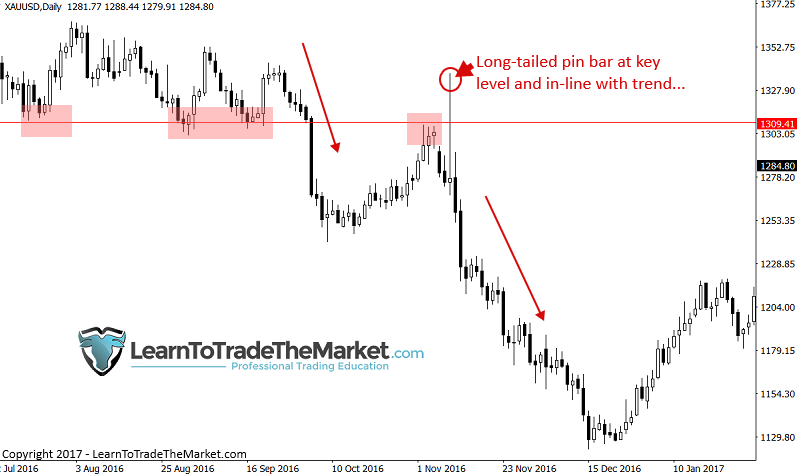
The best way to trade a long-tailed pin bar is the same as any other signal that I teach; with as much confluence as possible. When I talk about trading with confluence, I am talking about looking for trade signals that have come together with one or more pieces of evidence behind them. The main ones are T.L.S or trend, level, signal. So, ideally you want at least two of the three; trend and signal, or level and signal or even just trend and level (as in a blind entry). Note – there are more factors of confluence we can look for and I get into them more in-depth in my advanced trading course.
The chart example below shows us a good long-tailed pin bar with confluence of all three parts of T.L.S.
Counter-trend long-tailed pins with confluence
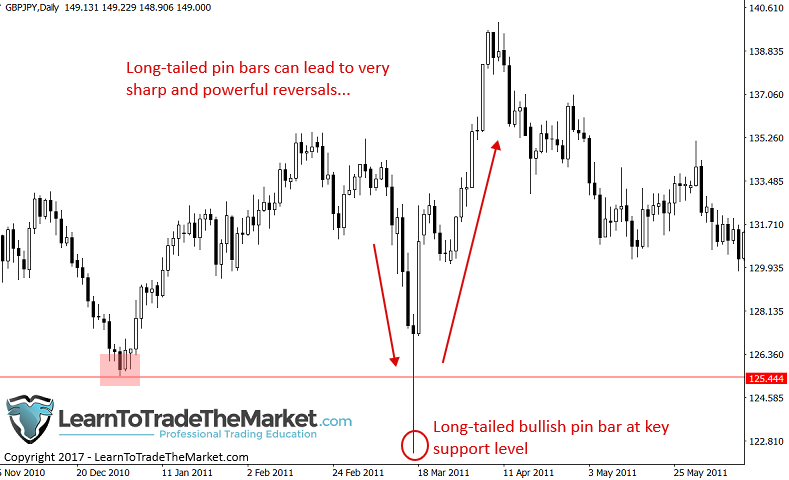
Often, because of the factors that lead to their formation, long-tailed pin bars will form counter to an existing trend or after a strong move up or down. With these pins, we want to look for protrusion through key levels, ideally within an obvious range. Or, we like to see the tail of the pin bar protruding through a level and making false-break of it. These things act as confluence for counter-trend long-tailed pin bars.
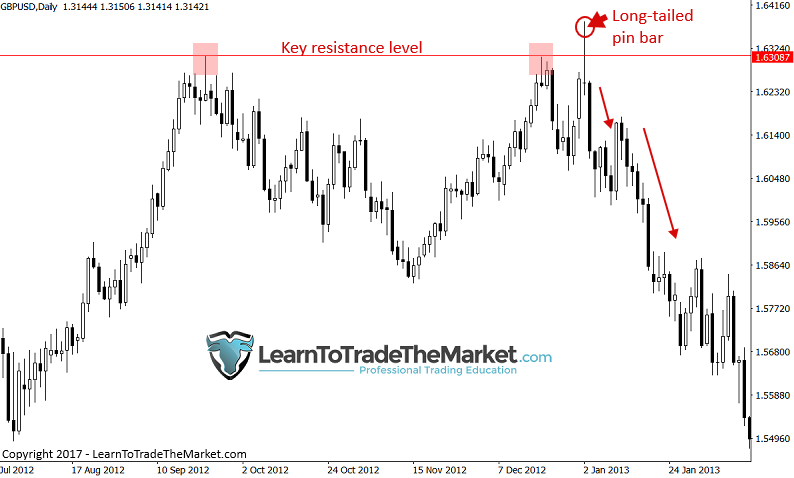
We may see a major reversal take place following a sustained move, this major reversal is often in the form of a long-tailed pin bar like in the example below. Think of it as the market ‘putting on the breaks’ after moving too far, too fast.
Long-tailed pin bars with trend and confluence
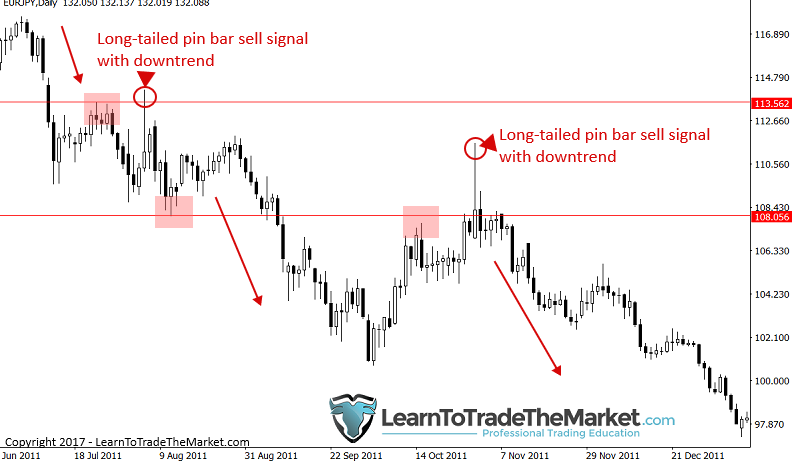
Long-tailed pin bars are very good trend-continuation signals as well. We can look for them after a pull back within a trend, as well as at or near key swing points.
Look for signal as continuation, but be warned seeing a large pin at the top or bottom of a trend move can actually be a warning sign of imminent collapse and reverse, so be careful on these.
Long-tailed pin bars as breakout plays
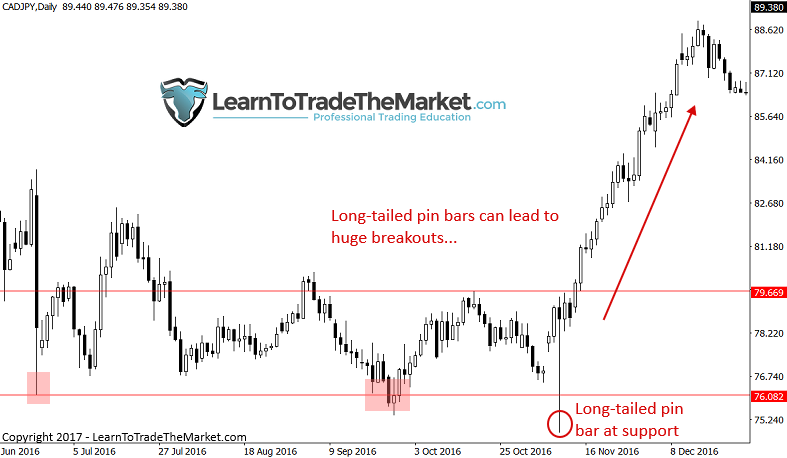
A market that has been in a trading range for a sustained period will eventually breakout in an aggressive manner, typically. When we get a long-tailed pin bar after a market has been range-bound for a long period, it is often a sign that such an aggressive breakout is about to happen…
Long-tailed pin bars can create event areas
You may have read my article on how to trade event areas and if you have you will probably remember that I mentioned long-tailed pin bars are one of the primary ways event areas are formed. Therefore, when a long-tailed pin bar forms, we want to make sure we watch that area closely as the market pulls back to it, even weeks or months later, because that long-tailed pin bar area is a powerful event area to look for second chance entries at…
How to enter long-tailed pin bars
There is essentially three different ways you can enter a long-tailed pin bar signal:
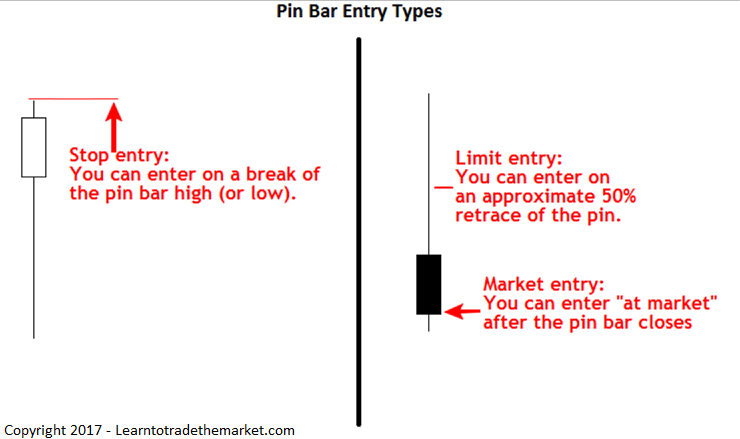
Whilst having knowledge of high-probability trade setups like long-tailed pins is very important, it is only one part of becoming a successful trader. The man or woman doing the analysis and pulling the trigger is JUST as important as the strategy or trading plan they are using.
As traders, we need to develop our subconscious gut trading feel on an ongoing basis, learn from the charts and keep notes and simply keep in touch with the day-to-day developments in the markets. This helps us develop a good intuition and gut feel which go hand in hand with a good trading strategy.
After fifteen years in the markets and about eight years of teaching traders, it’s obvious to me that most traders simply don’t know an obvious trade setup when it’s staring them in the face. With long-tailed pin bars, this problem is largely eliminated, because they are so large. For this reason, I recommend you make long-tailed pin bars the foundation of your price action trading plan.
So many traders miss great trades and so many traders tend to get stung by trading everything that they “think” might be a signal. This is like a madman with a gun walking around shooting anything that moves. Trading and money are weapons, so to speak, and just like a gun, you do need to be careful with it. You need to be patient and what for the best trades…then “pick your targets” and execute the trade with absolute precision and confidence.
My trading course covers all types of pin bars as well as my other price action setups. Combined with the daily members trade setups newsletter, you have a lot of resources to help you spot worth-while pin bar trades. Essentially, these resources allow you to look over my shoulder as I analyze the market, and this is the quickest way for you to learn how to trade profitably.
PLEASE LEAVE A COMMENT BELOW & GIVE ME YOUR FEEDBACK…
Any questions or want to talk ? Contact me here.
The post How to Trade Long Tailed Pin Bar Signals on Daily Charts first appeared on Learn To Trade The Market.